
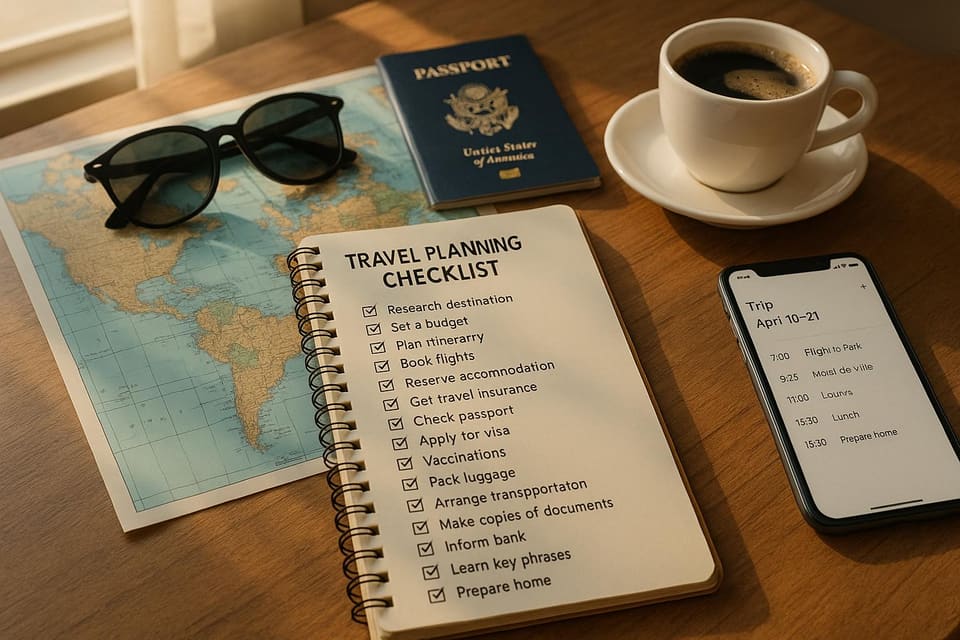
Planning a trip doesn’t have to be overwhelming. Here’s a quick checklist to make sure you’re fully prepared:
- Set Goals: Decide your travel style, budget, and must-see experiences.
- Research Requirements: Check passport validity, visa needs, vaccinations, and local laws.
- Create a Budget: Plan for flights, accommodations, meals, and unexpected expenses.
- Book Essentials: Secure flights, lodging, and transportation early for the best deals.
- Plan Your Itinerary: Balance activities with downtime, and leave room for spontaneity.
- Get Travel Insurance: Protect yourself from trip cancellations, medical emergencies, or lost luggage.
- Pack Smart: Use a weather-based packing list and include emergency items.
- Prepare Your Home: Secure your house, manage mail, and arrange for pet care.
- Set Up Travel Tech: Download essential apps, arrange for offline access, and check mobile plans.
- Protect Digital Info: Use a VPN, secure passwords, and monitor accounts for fraud.
- Track Your Trip: Use tools for real-time updates on flights, luggage, and safety.
- Review Post-Trip: Reflect on what worked, track expenses, and refine for future trips.
Quick Tip: AI planning tools like Highlights.AI can simplify your trip by creating tailored itineraries, tracking expenses, and suggesting activities based on your preferences. Start planning now and enjoy a stress-free adventure!
Step 1: Set Your Travel Goals and Preferences
Before jumping into flight deals or hotel options, pause for a moment. What do you _really_ want from this trip? Your travel goals and preferences will shape every choice you make.
"Setting travel goals is a powerful way to transform your wanderlust into tangible experiences." – Worldpackers
Start by defining your travel style. Are you someone who loves packed days of adventure? Or do you prefer slow mornings and laid-back afternoons? Maybe you're drawn to cultural experiences or indulgent fine dining. Whatever your style, understanding it will guide your decisions.
Think about your interests and passions. For example:
- If you're into photography, look for destinations with breathtaking landscapes or striking architecture.
- Love history? Ancient ruins or world-class museums might be your focus.
- If food is your thing, plan around culinary hotspots and local food tours.
Your budget will play a big role here, too. It might mean choosing between exploring one destination deeply or hopping between several. A 2023 survey by the Global Wellness Institute found that 78% of travelers experienced less stress after a week-long vacation. This highlights the importance of tailoring your trip to what truly matters to you - whether that's luxurious accommodations, unique activities, or unforgettable meals.
Time is another factor. A short trip might mean prioritizing just a few key attractions, while a longer one gives you more flexibility to explore. Tools like Highlights.AI can simplify this process by analyzing your interests, budget, and travel history to suggest destinations and activities that fit your vision.
When creating your bucket list, focus on experiences that genuinely excite you - not just the trendy spots you see on social media. Maybe you've always dreamed of seeing the Northern Lights, learning to make authentic pasta in Italy, or going on a safari in Kenya. These personal passions should guide your choices.
Don’t forget to consider who’s coming along. A romantic trip for two will look very different from a family vacation or a solo adventure. Group dynamics, ages, and individual preferences all play a role in shaping the perfect itinerary.
Above all, be honest with yourself. If you thrive on structure, don’t force yourself into a spontaneous backpacking trip. If you crave adventure and unpredictability, skip the rigid tour packages. Your travel goals should reflect what brings _you_ joy - not what you think a vacation "should" look like.
Step 2: Research Your Destination Requirements
Once you've set your travel goals, it's time to dive into the essential details about your destination. Forgetting something as simple as a visa or an expired passport can derail your plans. Here's what to keep in mind to ensure you're fully prepared.
Check your passport's validity. Many countries require your passport to be valid for at least six months beyond your travel dates, while others may only need it to be valid upon entry. To avoid any issues, the U.S. Department of State recommends renewing your passport nine months before it expires to account for potential delays.
Understand visa requirements and apply early. Depending on your destination, U.S. citizens may need a visa. Start by using the U.S. Department of State's "Learn About Your Destination" tool to find country-specific requirements. If an eVisa is an option, apply at least two months ahead of your trip, as processing times can vary. Remember, a visa doesn't guarantee entry - it simply means a consular officer has deemed you eligible to travel for your stated purpose.
Don't overlook health-related requirements. Some destinations mandate proof of vaccination, while others only suggest certain immunizations. Schedule a visit with your doctor or a travel health specialist 4–6 weeks before your trip to ensure you're up to date on any required vaccines. For example, if a yellow fever vaccine is necessary, you'll need to visit an authorized vaccination center. The CDC's destination pages and its TravWell app are excellent resources for personalized vaccine advice and travel preparation checklists.
Familiarize yourself with local laws and customs. Knowing the basics about your destination's legal and cultural expectations can help you avoid misunderstandings and show respect during your travels.
Leverage digital tools to stay organized. Apps like Highlights.AI can help you track important deadlines, while official resources like the CEAC Status Check let you monitor visa progress. If you change your address while waiting for visa approval, be sure to inform the U.S. Citizenship and Immigration Services (USCIS) promptly.
Starting this process 2–3 months before your departure gives you plenty of time to handle everything, from renewing your passport to managing vaccinations and visas. A little effort now can save you from headaches later, setting the stage for a smooth and enjoyable journey.
Step 3: Create and Manage Your Travel Budget
Planning a travel budget is like mapping out your financial guide to a successful trip. Without a solid plan, you might end up overspending or missing out on experiences. The trick is to anticipate all possible expenses and use smart tools to keep your costs in check.
Start with the big-ticket items. Your largest expenses will likely include flights, accommodations, and major activities. These are best researched early since they often take up a significant portion of your budget. For instance, domestic flights are typically cheapest when booked 1–3 months in advance, while international flights offer better deals when booked 2–6 months before takeoff.
Organize your budget into clear categories. Break down your expenses into smaller, manageable sections. Include everything - passport renewals (around $130), visa fees (about $30), travel insurance, vaccinations, transportation, meals, and communication costs. Don’t forget to set aside an emergency fund for unforeseen expenses. Once you’ve outlined your categories, use modern tools to refine your spending and snag the best deals.
Use AI tools to your advantage. Tools that predict price trends and send alerts for flights and accommodations can help you book at the right time, saving money.
Track spending on the go. Mobile apps that let you scan receipts and upload them instantly can keep you aware of your expenses while traveling. Some apps even categorize your receipts automatically, making it easier to adjust your budget if needed.
Streamline your itinerary with Highlights.AI. This AI-powered tool helps create efficient travel plans, minimizing transportation costs and saving time. With detailed itineraries starting at just $2–$7 per trip, it’s a small investment that can make a big difference.
Leave room for spontaneity. Set aside funds for those unplanned adventures or activities that might pop up during your trip. It’s a great way to explore freely while staying in control of your finances.
Research costs for your destination. Costs can vary widely depending on where you’re traveling. For example, Southeast Asia tends to be much more affordable than Australia or Europe. Look for travel creators who share detailed cost breakdowns to help you set realistic expectations. This research ties into later steps, ensuring your trip stays fun and financially manageable.
"Create a realistic travel budget by searching for vacation cost breakdowns by travel creators who share how much it actually costs to visit a destination." - Danielle Desir Corbett, personal finance and travel expert
Embrace money-saving tips. Consider staying in hostels for a more social and budget-friendly experience compared to hotels. Use public transportation instead of taxis, and look into options like the America the Beautiful annual pass ($80 for U.S. national parks) or Eurail Global Passes (starting at $315 for seven travel days).
Step 4: Book Your Accommodations and Transportation
Getting your accommodations and transportation right can set the tone for a hassle-free trip. The trick is to balance your priorities with safety and affordability.
Identify your must-haves first. Before diving into booking websites, figure out what’s non-negotiable for your trip. Is it a central location? Accessibility features? Or maybe family-friendly rooms? Knowing what matters most will help you stay focused and avoid feeling overwhelmed by endless options.
Understand your lodging choices and costs. Accommodation options range widely in price and style. For example, motels typically cost $50–$100 per night, inns fall between $100–$200, and hotels can start at $100 and go up to over $500 for luxury stays. Once you’ve nailed down your lodging, pick transportation that complements your travel plans and budget.
Streamline your search process. Stick to one or two booking platforms and use filters to narrow down options based on price, location, amenities, and guest ratings. Always check reviews for recent feedback, and be cautious of listings with outdated photos or vague descriptions.
Prioritize safety and accessibility. When booking accommodations, look for features like 24-hour desk service and reliable security. Reviews from recent guests can also provide valuable insights. A good tip: rooms located between the 3rd and 6th floors often offer better security and easier evacuation access. If accessibility is a concern, call ahead to confirm the availability of elevators, ramps, or accessible bathrooms.
Pick transportation that suits your needs. Choose a travel mode that works for your schedule, budget, and preferences. Cars give you privacy and flexibility, buses are a cost-effective choice for shorter distances, and flights are ideal for business or long-distance travel - though occasional delays are something to keep in mind.
Factor in timing and logistics. Research peak traffic hours in your destination and explore public transit options to avoid unnecessary delays. Traveling with a group? Look into group discounts and eco-friendly transportation options that can save money while reducing your environmental footprint.
Use AI tools for smarter booking. AI-powered platforms can help you snag the best deals by analyzing price trends and sending alerts. These tools can save travelers up to 40% on flights and accommodations. For instance, price alerts alone have been known to cut flight costs by as much as 30%, while transportation expenses can drop by around 20% overall.
"AI travel planners can take care of the organizational details required to make a travel itinerary, providing suggestions based on your team's preferences and browsing history."
- Booking.com for Business
Start tracking prices 3–4 months in advance. Set up real-time price alerts on trusted booking platforms to catch discounts as they happen.
Secure your ground transportation. For airport transfers, book in advance with licensed companies rather than relying on street hails. Look for services that provide ride records and driver details. If you’re using local taxis or rideshare apps, do some research ahead of time to ensure a safe experience. For air travel, remember your rights under the Air Carrier Access Act, which requires airlines to assist passengers with disabilities.
Try Highlights.AI for hassle-free planning. This AI-powered tool helps create detailed, budget-friendly itineraries covering everything from accommodations to daily activities. With plans available for just $2–$7 per trip, it’s an affordable way to stay organized.
Share your travel plans with someone you trust. Once you’ve booked everything, share key details - like hotel addresses, flight numbers, and transportation arrangements - with a trusted contact. It’s also a good idea to familiarize yourself with the locations of nearby hospitals, police stations, and other essential services in case of emergencies.
Step 5: Build a Flexible Daily Itinerary
Now that you've nailed down your bookings and budget, it's time to create a daily itinerary that brings your trip to life. The trick is to strike a balance - structured enough to stay organized but loose enough to embrace those unexpected, unforgettable moments.
Use AI tools for tailored travel planning AI trip planners are game-changers, using advanced tech to deliver recommendations that fit your preferences perfectly. These tools process details like your destination, travel dates, and preferred activities to create custom itineraries. The more specific you are, the better the results. This approach ensures a mix of planned highlights and unplanned relaxation, making your trip both efficient and enjoyable.
Mix must-see sights with downtime Packing your days with activities might sound exciting, but it can quickly lead to burnout. Experts suggest scheduling at least one rest day for every two to three days of sightseeing. For shorter trips, a single rest day might suffice, while longer journeys or multi-destination adventures should include regular breaks. If your trip involves long flights or train rides, plan for extra downtime to recover.
Plan for bad weather Weather can be unpredictable, so having backup indoor activities is a smart move. Museums, local classes, or cultural sites can save the day when the skies don’t cooperate. If you're heading to high-altitude destinations, be ready to adjust your plans if altitude sickness strikes. Keeping your itinerary flexible ensures you can adapt without stress.
Avoid overloading your schedule Trying to cram too much into one day - like multiple museum visits - can leave you feeling drained. Limit yourself to one museum per day and mix it up with other activities like walking tours or historical sites. Don’t forget to factor in meal breaks - they’re a perfect opportunity to relax and recharge.
"Too much rigidity means zero spontaneity. Unplanned moments often become the best part of an adventure." – Tino Roco
Combat travel fatigue with intentional downtime Even short trips can take a toll if you're constantly on the go. For longer adventures, the risk of anxiety or burnout increases when you're traveling nonstop. Scheduling downtime for relaxing activities like yoga or meditation can help you recharge. Staying in one location for a few days also reduces the stress of constant movement.
Digital nomad David Jordan shares: "Trip Planner AI saves time and stress by aiding travel planning, relieving indecision or uncertainty". Similarly, student Steve J says: "I love traveling but hate planning. This app quickly organizes trip agendas, reducing decision fatigue".
Try Highlights.AI for smarter planning Platforms like Highlights.AI make itinerary creation easy and affordable, with plans starting at just $2–$7 per trip. These tools help you design itineraries that balance must-see spots with downtime, all tailored to your travel style.
Leave room for spontaneity Every great trip needs a little wiggle room. Skip overplanning and leave gaps in your schedule for unexpected discoveries, leisurely meals, or simply wandering around. Often, these unplanned moments become the highlights of your journey.
Include nature for stress relief Whenever possible, add nature-based activities to your itinerary. Whether it’s a stroll through a park, a hike, or a visit to a botanical garden, being in nature can help you relax and recharge between busier activities.
Think of your AI-generated itinerary as a guide, not a rulebook. It’s there to help you make the most of your trip while leaving space for those magical, unplanned experiences.
Step 6: Get Travel Insurance Coverage
Once your itinerary and bookings are finalized, it’s time to add an extra layer of security with travel insurance. While planning and budgeting ensure your trip runs smoothly, insurance protects you from unexpected setbacks. From medical emergencies in a foreign country to last-minute flight cancellations, travel insurance can save you from significant financial stress.
Opt for broad coverage to stay protected Comprehensive travel insurance is often the go-to choice, covering a wide range of potential issues. These plans account for about 65% of policies sold through Squaremouth and typically include trip cancellations, interruptions, medical emergencies, medical evacuations, travel delays, and baggage problems. On average, they cost between 5-10% of your trip expenses - around $400 for most travelers - and provide extensive protection.
If you’re looking for a more affordable option, travel medical insurance might be a better fit. These plans, averaging $95 in 2023, cover medical emergencies and evacuations but don’t include trip cancellation benefits.
Understand the specifics of your policy Not all travel insurance policies are the same, so it’s essential to know what you’re signing up for. Emergency medical evacuation coverage is especially important if you’re traveling to remote areas with limited healthcare options. Trip cancellation and interruption insurance can reimburse nonrefundable costs if illness, injury, or family emergencies disrupt your plans. Baggage insurance helps cover losses or damages to your luggage, though there are often limits on high-value items.
"Travel insurance can minimize the considerable financial risks of traveling: accidents, illness, missed flights, canceled tours, lost baggage, theft, terrorism, travel-company bankruptcies, emergency evacuation, and getting your body home if you die." - Rick Steves
Leverage AI for customized coverage AI technology is making it easier than ever to tailor insurance to your specific needs. By analyzing factors like your destination, planned activities, and medical history, AI tools can recommend the most suitable coverage and even speed up claims processing. For instance, one US-based insurer handling 400,000 claims annually has reduced processing times from weeks to just minutes using AI.
"Imagine a world where most insurance claims are processed in hours instead of days. A computer system can go out and collect all the documentation for you and prepare the paperwork perfectly, ready for a human to make a quick decision on whether to approve it or not." - Daniel Green, chief technology officer, Faye Travel Insurance
Don’t overlook coverage for adventurous activities If your trip involves high-risk activities, such as scuba diving or skydiving, specialized insurance is crucial. With roughly 2.5 million Americans scuba diving annually and the Divers Alert Network reporting 1,000 diving-related injuries each year - over 10% of which are fatal - having the right coverage is non-negotiable. Many insurers now offer add-ons or separate policies for adventure sports, which is great news for thrill-seekers. For example, in 2024, approximately 42,000 members of the US Parachute Association are expected to perform 3.9 million jumps.
Buy at the right time and review your options To get the most out of your insurance, purchase it within a week of making your first trip payment. This timing ensures you qualify for maximum benefits. If you already have health insurance, check whether it includes international coverage before buying additional medical insurance. For trips involving significant prepaid, non-refundable expenses, comprehensive coverage is highly recommended.
If you encounter any issues during your travels, contact your insurance provider immediately to understand the claims process. Whether you spend $95 on basic medical insurance or $400 on comprehensive coverage, the peace of mind it provides far outweighs the potential costs of an uninsured emergency abroad.
Step 7: Create Smart Packing Lists
With your travel insurance sorted, it’s time to tackle one of the most important - and sometimes stressful - parts of trip prep: packing. A thoughtful packing list can mean the difference between a smooth trip and a chaotic one filled with forgotten essentials or overweight baggage fees.
Start with Climate and Activity Research
Check the weather at your destination about three days before you leave. Don’t just look at the temperature - dig into the details. Is there a chance of rain? If so, skip packing items like leather, suede, velvet, or silk that can be easily damaged by moisture.
"Packing for transitional weather is all about versatility." - Priyanka Swamy, founder of Perfect Locks LLC
When deciding what to pack, focus on three key factors: the events you’ll attend (style), the activities you’ll do (comfort), and the weather you’ll face (function). For example, packing for a business trip to Chicago in February will look very different from preparing for a beach getaway in Miami during the same month.
Pick Versatile, Weather-Appropriate Clothing
Choose clothing that you can mix, match, and layer. Layers are especially useful for changing weather conditions. For instance, a lightweight shell can double as a raincoat or an extra layer for warmth. Accessories like scarves, shawls, or pashminas are great for both style and practicality.
Start planning your outfits by selecting shoes first, then build a color scheme around them. Limit yourself to just a few pairs that work for multiple activities, and wear your heaviest pair while traveling to save space in your luggage.
Use AI for Packing Optimization
AI tools can help you pack smarter by analyzing your destination, weather, and planned activities to create a customized packing list. These tools recommend versatile clothing options to reduce the number of items you need while ensuring you’re ready for anything.
"AI tailors your list specifically based on destination, activities, and personal preferences - creating something completely personalized to each adventure!"
AI even takes microclimates and travel styles into account, offering suggestions like hiking boots for outdoor adventures or formal wear for business events. It can also provide guidance on dressing appropriately for local customs. Tools like PackPoint and Trvl Porter are great examples - they generate tailored packing lists and even analyze your habits to help you pack lighter and smarter.
Pack Smart to Save Space and Weight
To maximize space, roll wrinkle-resistant clothes instead of folding them. Place heavier items like jackets or jeans at the bottom of your bag and lighter clothes on top to balance the weight.
For longer trips, pack travel detergent so you can do laundry on the go instead of bringing extra outfits. This trick saves both space and weight.
Don’t Forget Emergency Essentials
No packing list is complete without an emergency kit. Former Navy SEAL Harding Bush, now a senior manager for security operations at Global Rescue, stresses the importance of being prepared:
"Whether you're traveling to a potentially dangerous region or already in one, preparing a go bag packed with key items will increase your likelihood of safety or even survival when it's necessary to immediately relocate to a safer area or depart the region at less than a moment's notice".
Your emergency kit should include basics like adhesive bandages, antibacterial ointment, alcohol wipes, and any personal medications in their original packaging. Keep copies of prescriptions handy, and ensure medications are easy to access. Other essentials include a small flashlight, extra batteries, and a whistle for signaling.
Practical items like hand sanitizer, electrolyte powder, motion sickness medicine, and zip-top bags can also come in handy. Carry emergency cash in different bags for added security. Include a list of emergency contacts, such as local authorities, your embassy, and family members.
Store your emergency items in airtight plastic bags and keep them in an easy-to-carry container. Regularly check expiration dates and replace items as needed to ensure your kit stays ready for any situation. Packing these essentials not only keeps you prepared but also adds peace of mind to your travels.
Step 8: Prepare Your Home Before Leaving
Once your bags are packed, it’s time to focus on securing your home. A little preparation can go a long way in keeping your property safe and giving you peace of mind while you're away.
Automate Your Home with Smart Devices
Smart devices can make your home feel lived-in, save energy, and boost security while you're gone. Start with your thermostat - set it to vacation mode or adjust temperature settings to avoid wasting energy. For lighting, use smart plugs and timers to vary the schedule each evening, creating the illusion of activity. For example, a TP-Link Kasa Smart Plug Mini costs about $15 and can help you control lights and small appliances remotely. You can also use automated window shades to add another layer of realism.
Secure Access Points and Monitor Remotely
Smart locks are a great way to manage access while you're away. The August Wi-Fi Smart Lock, priced around $130, lets you assign temporary virtual keys that you can revoke anytime. Similarly, a smart garage door controller ensures your garage isn’t accidentally left open. Check that all your security systems and detectors are working properly before you leave.
Use AI for Smarter Security
AI-powered security systems can take home monitoring to another level. These systems can identify unusual sounds, recognize people, and filter out normal activities like pet movements or package deliveries. As Sam Moxey of Barry Bros Security puts it:
"Artificial intelligence is transforming many areas of life and work, not least home security courtesy of its innate ability to recognise specific people, detect out of the ordinary sounds and filter out unusual behaviours."
For outdoor monitoring, consider the Arlo Pro 5S security camera (about $250 ), which offers excellent 2K resolution and a wide 160-degree field of view. Indoors, the Eufy S330 Floodlight Camera (around $230 ) combines bright lighting with clear video and smart tracking. A smart doorbell, like the Arlo Video Doorbell (approximately $79 ), lets you see and talk to visitors remotely. By integrating these AI-powered devices, you can create a cohesive and reliable home security system.
Check Safety Systems and Detectors
Double-check that all security devices - like cameras and smart doorbells - are fully operational. Ensure batteries are charged, connections are stable, and firmware is updated. For environmental safety, test your smoke, carbon monoxide, and water leak detectors. Replace batteries and confirm that notification settings are accurate. Smart detectors can send alerts directly to your phone, helping you respond quickly to potential issues.
Arrange Care for Pets, Plants, and Mail
If your pets can’t join you, arrange for a sitter or boarding. Make sure their microchip information is current, and leave detailed care instructions along with emergency contacts for your vet. Stock up on food and supplies before you go.
For plants, set up self-watering systems ahead of time and test them to ensure they work properly. Give your plants a thorough watering before you leave, and use terrarium methods for moisture-loving varieties, keeping them out of direct sunlight.
To manage your mail, use USPS forwarding services or temporary mail forwarding for up to 12 months. This prevents mail from piling up, which could signal your absence.
Final Automation Check
Before you leave, do a final test of all your smart devices. Turn off any unnecessary schedules to conserve battery life and avoid false alarms. Use smart plugs to minimize phantom power drain from devices that don’t need to stay on. As Tyler Lacoma, Editor of Home Security, explains:
"The best thing about these steps is that once you have the settings ready, you can switch back to them any time you're out of town, saving plenty of time."
With everything set, you can head out knowing your home is secure and ready for your return.
Step 9: Set Up Your Travel Technology
Once your travel itinerary is ready, it’s time to ensure your devices are equipped to keep you connected and organized while on the move. From essential apps to reliable communication tools, setting up your tech in advance can make your trip smoother and more enjoyable.
Download and Test Essential Travel Apps
Before you leave, download and test the travel apps you'll rely on. Make sure they work offline and cover these key categories:
- Planning and Organizing: Apps like _Google Travel_ or _TripIt_ help manage itineraries.
- Search and Booking: Use tools like _Airbnb_ or _Skyscanner_ for accommodations and flights.
- Navigation: Apps such as _Google Maps_ or _AllTrails_ are perfect for getting around.
- Recommendations: Check out _TripAdvisor_ or _Yelp_ for local dining and attractions.
Enable notifications on your airline and hotel apps to get real-time updates about your bookings.
Set Up Offline Access for Key Information
Prepare for moments when you might not have internet access. Download offline maps using _Google Maps_ and offline language packs with _Google Translate_. Save your itinerary - including flight numbers, hotel reservations, and other details - in apps like _TripIt_ or _Google Travel_. For a more comprehensive offline solution, consider using _Tripsy_.
Secure Reliable Communication
Check your mobile carrier’s international coverage and roaming options. For example, Verizon offers TravelPass at $10 per day or an International Monthly Plan for $100, while T-Mobile provides unlimited texting and up to 5GB of high-speed data in over 215 countries. Alternatively, unlock your phone to use local SIM cards or eSIMs. Services like _Airalo_ provide affordable data plans, such as 1GB for 7 days at $5 or 100GB for 180 days at $185, which can be much cheaper than traditional roaming.
Once your communication setup is sorted, prepare a list of emergency contacts and ensure you have access to essential information in case of unexpected situations.
Set Up Emergency Communication
Keep important documents, emails, and webpages saved for offline access. Create a printed list of emergency phone numbers, including your hotel, local authorities, and your country’s embassy. If you need to call the United States while abroad, dial the plus sign (+), followed by 1 and the area code.
Sync with AI-Powered Planning Tools
Take your travel planning to the next level by integrating AI-powered tools. Platforms like _Highlights.AI_ can generate personalized itineraries that sync across your devices, ensuring critical travel details - like maps, emergency contacts, and reservations - are accessible both online and offline.
As Brian Lam, founder of Wirecutter, wisely said:
"Traveling well is a fine balance between finding inspiration in the unknown while being grounded in something... Sometimes it's just the familiar, reliable stuff in your bag."
Step 10: Protect Your Digital Information
Once your devices are ready and you're connected, it's time to safeguard your digital world while traveling. Cybercriminals often target tourists through insecure networks, making digital security a must-have for any traveler.
Secure Your Internet Connection with a VPN
Public Wi‑Fi networks - like those in airports, hotels, and cafes - are convenient but often lack proper encryption. This makes it easy for hackers to intercept your online activity. Worse, some cybercriminals create fake hotspots with names that mimic legitimate networks to trap unsuspecting users.
Using a Virtual Private Network (VPN) is a smart way to protect your connection. A VPN encrypts your internet traffic and hides your IP address, creating a secure tunnel for your data. Subbu Sthanu, Chief Commercial Officer at IPVanish, explains:
"A VPN encrypts your traffic and conceals your IP address from websites."
Popular VPN services like NordVPN, ExpressVPN, Surfshark, and Proton VPN offer servers in over 100 countries, making them reliable choices for travelers. Even on cellular networks, a VPN ensures your data stays encrypted.
Leverage AI-Powered Fraud Detection
Fraud in the travel industry is on the rise, with Booking.com reporting a staggering 500 to 900% increase in travel scams over the past 18 months. AI-driven fraud detection tools can help by analyzing your spending patterns, flagging unusual activity, and preventing unauthorized charges.
Travel Industry Solutions provides specialized fraud prevention for travel professionals. As CEO Sheila Folk explains:
"We built our fraud prevention feature specifically to address the needs of travel professionals, combining decades of machine learning and AI to deliver real-time, actionable risk scores."
The results speak for themselves - PetSmart saved up to $12 million by using AI fraud detection to verify millions of transactions.
Store Documents Securely with Encrypted Cloud Storage
Keeping your documents secure is just as important as protecting your network. Digitally store important files like your passport, driver's license, travel insurance, and itineraries in encrypted cloud storage. This ensures you can access them from anywhere while keeping them safe from unauthorized access. Many cloud storage solutions use zero-knowledge encryption, meaning even the service provider can't view your files.
Here are some top encrypted cloud storage options:
| Solution | Starting Cost | Storage | Key Features |
|---|---|---|---|
| Sync.com | $5/month | 200 GB | Easy to use, strong security |
| IDrive | $2.95/year | 100 GB | Affordable, versatile data management |
| pCloud | $49.99/year | 500 GB | Multi-device access, lifetime plans offered |
| NordLocker | $2.99/month | 500 GB | Works seamlessly with other Nord products |
| Internxt | ~$2/month | 1 TB | Privacy-first, military-grade encryption |
All of these options use AES‑256 encryption, the same standard trusted by governments and militaries worldwide.
Practice Smart Digital Hygiene
Be cautious when using public Wi‑Fi. Avoid accessing sensitive information like banking apps or email accounts on these networks. If necessary, switch to your cellular data for added security.
Keep your devices and software updated to ensure you have the latest security patches. Enable two-factor authentication (2FA) on your accounts, use strong, unique passwords, and consider using a password manager to securely store and generate complex passwords.
Monitor Your Accounts in Real Time
Set up account alerts with your bank and credit card providers to receive instant notifications for any transactions. Many financial institutions now offer AI-powered tools to monitor spending patterns and detect suspicious activity. This is especially useful when traveling, as worldwide credit card losses are projected to hit $43 billion by 2026.
Step 11: Track Your Trip in Real Time
Once you've taken steps to secure your digital information, the next priority is keeping tabs on your trip as it unfolds. Travel disruptions are more frequent than most people realize. In 2024 alone, over 236 million passengers in the U.S. dealt with flight delays and cancellations. Thankfully, AI-powered tracking tools can help you stay informed and adjust your plans as needed.
Get Ahead of Flight Changes
AI-powered flight tracking apps are game-changers when it comes to staying ahead of delays. These tools use machine learning to analyze factors like inbound aircraft schedules, weather conditions, and air traffic control updates. Often, they alert users to potential issues before airlines make official announcements. For instance, many travelers have shared experiences of receiving delay notifications through apps well before hearing from gate agents. Travel expert David Pogue highlights this advantage:
"Often tells me about delays before the airline does!"
Similarly, Brian Kelly points out:
"Flighty alerts me before the gate agents even know of a change".
This early warning system gives you a valuable head start, whether it's rebooking a flight or adjusting your travel plans.
Keep Track of Your Luggage
Lost or mishandled luggage is a common headache, but smart tracking technology is making it easier to keep tabs on your belongings. The market for Airport Baggage Handling Systems is projected to hit $14.3 billion by 2030, driven by the growing demand for real-time tracking tools. GPS trackers and RFID systems now allow travelers to monitor their luggage through mobile apps. These devices can send alerts if your bag moves outside a designated area and provide live location updates. Additionally, many airports are adopting RFID-integrated systems to speed up and improve the accuracy of baggage handling.
Stay Updated on Safety and Security
AI tools can also help you stay informed about weather, traffic, and safety concerns, keeping your trip as smooth and secure as possible. These apps provide real-time updates on emergencies like natural disasters, political unrest, or unexpected travel restrictions [18, 153]. They can even offer alternative routes, recommend safe accommodations, and connect you with local emergency contacts. Whether it’s rebooking a flight during a storm or finding a way around a public transit disruption, these tools ensure you're never left scrambling.
Use Real-Time Data to Refine Your Plans
The use of generative AI in travel is growing rapidly, with the market expected to expand from $894.33 million in 2024 to about $5.067 billion by 2034. These tools are not only faster and more adaptable than traditional travel agencies, but they also save money. For example, price alerts can notify you of sudden fare drops, while real-time recommendations ensure you’re making the most of your trip. Many AI assistants are accessible through popular platforms like WhatsApp, LINE, Telegram, and Facebook Messenger, so you can get help no matter where you are.
Step 12: Review Your Trip After You Return
Once you're back from your trip, take some time to reflect on your experience. Reviewing your journey can help you spot areas for improvement, trim costs, and address any hiccups that might have disrupted your travels. With AI-powered tools, this process becomes much simpler and more insightful.
Create Automated Travel Journals with AI
AI journal apps can turn your travel memories into organized, detailed records with minimal effort. These tools can transcribe voice notes, caption photos, and sort entries by date, location, or theme. A great example comes from March 2025, when Filip Oborník used ChatGPT to transform his spoken travel stories into polished journal entries that closely matched his writing style.
"Voice-to-text in journal apps makes it easier to write and gets people to use their journals more." - Restackio
These apps also provide helpful writing prompts if you're unsure where to start and automatically correct spelling and grammar, making journaling more accessible and enjoyable.
Analyze Your Trip Expenses Intelligently
Managing travel expenses can be tedious, but AI tools simplify the task by categorizing and analyzing your spending. These tools can sync with your bank accounts, track spending patterns, and highlight ways to save money on future trips. By reviewing this data, you can adjust your budget and plan smarter for upcoming adventures.
After reviewing financial details, take a moment to reflect on what worked well during your trip and what could be improved.
Gather Comprehensive Feedback
AI tools, combined with sentiment analysis, can offer a fresh perspective on your travel feedback. By using natural language processing and machine learning, these tools can identify patterns and insights that might escape a simple manual review. Consider reflecting on the following aspects:
- Transportation and logistics: Were there any issues during flights, layovers, or with local transportation?
- Accommodations and safety: Were your accommodations up to standard? Did you feel safe throughout your stay?
- Overall experience: Was the trip well-organized? Are there areas in your planning process that could be improved?
This feedback can be invaluable for fine-tuning your future travel plans.
Apply Your Insights for Future Trips
The real benefit of a post-trip review lies in using the insights to enhance your next adventure. AI can uncover patterns - like recurring issues with certain airlines or neighborhoods - that might go unnoticed otherwise. Whether you're planning a business trip, a family vacation, or a solo getaway, tailoring these insights to your travel style can help you create a more enjoyable experience.
Incorporate these learnings into your future planning checklist. Sharing your experiences, both positive and negative, can also play a role in shaping your satisfaction. Research suggests that sharing positive travel moments enhances overall enjoyment, while acknowledging and addressing negatives can help reduce their lingering effects.
Conclusion: Smarter Travel with Highlights.AI
Planning a trip can feel overwhelming, but with this 15-step checklist, you're equipped to turn your travel dreams into reality. From setting goals to reflecting on your adventure afterward, each step is designed to make your journey smooth and enjoyable, covering every essential detail along the way.
Did you know that around 70% of Americans now use AI tools for travel planning? And among younger generations, the trend is even stronger - 53% of Gen Z and 57% of Millennials prefer personalized AI-assisted travel planning. It's not just about saving time; it's about creating experiences that truly resonate with your preferences.
"I think artificial intelligence can keep the joy in planning while eliminating the work."
- Harriet Brown, Vice President of Product, Mobi AI
Highlights.AI takes the stress out of planning by offering geographically optimized itineraries to reduce travel time between attractions. Whether you're moving at a fast pace or taking things slow, the tool adapts to your style with flexible customization. It even generates detailed, day-by-day plans, including activities, dining options, and transport arrangements - all tailored to your unique travel goals.
To make the most of AI-powered planning, start with clear prompts. Share your preferences, budget, and must-haves to guide the tool effectively. While AI's accuracy stands at 70–80%, it provides a solid foundation that you can tweak to perfection.
By using Highlights.AI alongside this checklist, you're not just planning a trip - you’re crafting an adventure that’s efficient, stress-free, and fun. Whether it’s a quick weekend escape or a month-long international tour, let AI handle the logistics while you focus on making memories. With just a few clicks, your next journey is ready to begin.
The future of travel planning is here, and it’s making the world more accessible - one trip at a time.
How Highlights.AI Transforms Travel Planning
Highlights.AI takes the hassle out of planning trips by using AI-driven tools to craft personalized itineraries and handle essential steps for you. It dives into your preferences, past travel experiences, and goals to suggest destinations, activities, and accommodations that align perfectly with your style. The result? A travel plan that saves you hours of research and effort.
Beyond just recommendations, the platform creates detailed, day-by-day schedules. These include activities, meal spots, and logistics, so you don’t have to spend time piecing everything together. Plus, with features like automated bookings and real-time updates, you can stay on top of your plans and adjust seamlessly if things change. Highlights.AI ensures your trip is not just well-organized but also stress-free and enjoyable.
How can I set travel goals and preferences to plan a trip that feels truly rewarding?
To plan a trip that feels rewarding, start by figuring out what’s most important to you. Are you looking for relaxation, adventure, cultural experiences, or maybe even personal growth? Once you know, align your travel plans with your values - whether that's supporting local communities, learning new things, or focusing on eco-conscious choices. For instance, if sustainability matters to you, look for eco-friendly accommodations or activities that benefit local businesses.
A little preparation goes a long way toward making your trip smooth and enjoyable. Research your destination, familiarize yourself with local customs, and set a budget that prioritizes the experiences you’ll treasure most. By planning with clear goals and preferences in mind, you’ll create a trip that’s both memorable and meaningful.
Why is travel insurance essential, and what should it cover?
Travel insurance plays a crucial role in shielding you from unexpected expenses like trip cancellations, medical emergencies, or misplaced belongings. It offers not just financial protection but also peace of mind - especially when venturing overseas, where your regular health insurance might not cover you.
When selecting a travel insurance plan, focus on these key coverage areas:
- Trip cancellation: This reimburses non-refundable costs if unforeseen events, like an illness or severe weather, force you to cancel your plans.
- Medical coverage: Essential for covering healthcare expenses if you fall ill or get injured during your trip.
- Emergency evacuation: Covers transportation costs if you require urgent medical care or need to be evacuated.
Choosing the right travel insurance can spare you from major financial headaches and help make your trip far less stressful.