
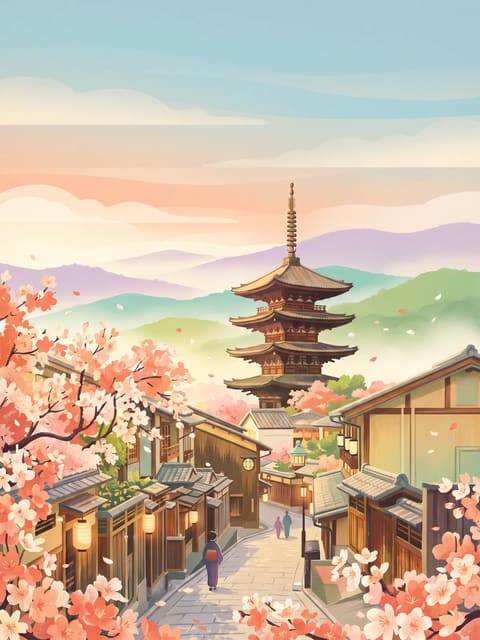
A first Japan itinerary goes Tokyo, Kyoto, Osaka by bullet train: fly into Tokyo, out of Osaka's Kansai airport, and give each city at least two nights. Our 7-day plan spends 3 nights in Tokyo, 3 in Kyoto and the last in Osaka, flying home the next morning; our 10-day plan adds a fourth Tokyo night and one in Hakone for Mount Fuji. With 12 to 14 days, add Hiroshima and Miyajima; with 21, the Japanese Alps and Kanazawa. The Nozomi bullet train links Tokyo and Kyoto in about 2 hours 15 minutes.
Fares, prices and dates on this page were checked on November 21, 2026, on each operator's or sight's own site. The plans in the row above are ours: each is a day-by-day route with times, prices and booking notes, $5, opened in the Highlights app.
How many days do you need in Japan?
You need 7 to 10 days in Japan for Tokyo, Kyoto and Osaka without rushing, and 14 days to add Hiroshima and a slower pace. Here is how the nights split for each length, and where each one is written out day by day:
| Trip | Nights per stop | Day-by-day route |
|---|---|---|
| 5 days | Tokyo 2, Kyoto 2 | Japan itinerary for 5 days |
| 7 days | Tokyo 3, Kyoto 3, Osaka 1 (Nara on the way; fly home on day 8) | Japan in 7 days |
| 10 days | Tokyo 4, Hakone 1, Kyoto 3, Osaka 1 (Nara as a day trip) | Japan in 10 days |
| 14 days | Tokyo 4, Hakone 1, Kyoto 4, Hiroshima 2, Osaka 2 | Japan itinerary for 2 weeks |
| 21 days | Tokyo 4, Nikko 1, Fuji 1, Matsumoto 1, Takayama 2, Kanazawa 2, Kyoto 4, Hiroshima 2, Osaka 3 | Japan itinerary for 3 weeks |
| One city | Tokyo 3 to 5, Kyoto 2 to 3, Osaka 2 to 3 | 3 days in Tokyo, Kyoto in 2 days, Osaka itinerary |
Keep moves to one every two or three days: each hotel change costs about half a day of packing, checking out and finding the next place.
What is the best route for a first trip to Japan?
The best first route is Tokyo, then Hakone or Mount Fuji, then Kyoto with a day in Nara, then Osaka, flying home from Kansai International (KIX). It runs one way down the Tokaido Shinkansen line, so you never go back on yourself, and an open-jaw ticket (into Tokyo's Haneda or Narita, out of KIX) saves the day a return to Tokyo would cost. Our Japan in 10 days plan follows it:
- Days 1 to 4, Tokyo: Senso-ji in Asakusa at golden hour on arrival day; Tsukiji's outer market for breakfast, teamLab, Hamarikyu gardens and Shibuya Crossing at dusk; Ueno, Meiji Jingu and Harajuku; a day trip to Kamakura's Great Buddha.
- Day 5, Hakone: the Romancecar from Shinjuku, the ropeway over Owakudani's sulfur vents, the boat across Lake Ashi, a night in an onsen ryokan, an inn with hot-spring baths and dinner.
- Days 6 to 8, Kyoto and Nara: Nishiki Market and Gion at dusk; Fushimi Inari at 6 a.m., Kiyomizu-dera and the stone lanes of Sannenzaka; Nara's deer and Todai-ji's Great Buddha.
- Days 9 and 10, Kyoto to Osaka: Arashiyama's bamboo at dawn and Kinkaku-ji, then Osaka Castle, Dotonbori and a Kuromon Market breakfast before the train to KIX.
With a week, drop Hakone and Kamakura: that is our Japan in 7 days plan. In cherry blossom season, the cherry blossom plan times the same cities to the bloom; see when cherry blossom season is for the dates by city.
How do you get between Tokyo, Kyoto and Osaka?
You get between Tokyo, Kyoto and Osaka by Shinkansen (bullet train) on the Tokaido line, and every other leg of a first trip is a short local or express train. Times and one-way adult fares, from each railway's own site (checked November 21, 2026):
| Leg | Time | Adult fare |
|---|---|---|
| Haneda Airport to Shinagawa, Keikyu | About 14 min | ¥330 |
| Narita Airport to Tokyo, Narita Express | 53 min at the fastest | ¥3,140 |
| Shinjuku to Hakone-Yumoto, Odakyu Romancecar | About 80 min | ¥1,200 plus the ¥7,100 Hakone Freepass |
| Tokyo to Kyoto, Nozomi | About 2 h 15 min | ¥14,170 |
| Tokyo to Shin-Osaka, Nozomi | 2 h 21 min at the fastest | ¥14,720 |
| Kyoto to Nara, Kintetsu | About 35 min by limited express | ¥760, plus ¥520 for a limited express |
| Shin-Osaka to Hiroshima, Nozomi | 1 h 19 min at the fastest | ¥10,950 |
| Kansai Airport to Namba, Nankai Rapi:t | 34 min at the fastest | ¥1,670 |
| Kansai Airport to Kyoto, JR Haruka | About 76 to 82 min | ¥2,700 with JR West's visitor ticket |
Shinkansen fares are for a reserved seat in the regular season. For tickets bought from July 1, 2027, JR Central and JR West raise the Nozomi reserved-seat charge: ¥700 more from Tokyo to Kyoto or Shin-Osaka, ¥260 more from Shin-Osaka to Hiroshima.
Buy Shinkansen tickets at the station machines or on JR Central's smartEX site. Seats on the right side going west (seat E in ordinary cars) face Mount Fuji: in our 7-day plan, it appears between Shin-Yokohama and Shizuoka on a clear morning. For city trains, tap an IC card such as Suica or ICOCA (more under "What do you need to know before you go to Japan?" below).
Is the JR Pass worth it for a Japan itinerary?
The JR Pass is not worth it for most first trips: Tokyo to Kyoto to Osaka with the train to Kansai airport adds up to about a third of what the 7-day pass costs. Even Tokyo to Hiroshima and back by Nozomi, ¥19,760 each way (JR Central and JR West), costs less than the pass. Japan Rail Pass prices bought online (official Japan Rail Pass site, checked November 21, 2026): ordinary cars ¥50,000 for 7 days, ¥80,000 for 14, ¥100,000 for 21; Green (first class) cars ¥70,000, ¥110,000 and ¥140,000. On the Nozomi, pass holders also need a special ticket. If a longer route does make the pass pay, start it on the day of your first long JR ride, since its days run back to back.
| Trip | Single JR tickets | JR Pass |
|---|---|---|
| 7 days: Tokyo to Kyoto by Nozomi, Kyoto to Osaka, then Osaka to Kansai airport | About ¥16,650 | ¥50,000 (7 days) |
| Tokyo to Hiroshima and back by Nozomi | ¥39,520 | ¥50,000 (7 days) |
| 14 days: our 2-week route | About ¥36,700 | ¥80,000 (14 days) |
| 21 days: our 3-week route | About ¥38,500 | ¥100,000 (21 days) |
The pass also covers the JR airport trains and the JR Yamanote line in Tokyo, but not the private railways (Odakyu to Hakone, Kintetsu to Nara, Nankai to KIX) or the subway. Our trip cost page has the other prices.
What should you see in Tokyo, Kyoto and Osaka?
See Senso-ji, Shibuya Crossing and Meiji Jingu in Tokyo, Fushimi Inari, Kiyomizu-dera and Kinkaku-ji in Kyoto, and Dotonbori and Osaka Castle in Osaka, taking Tokyo by neighborhood, Kyoto by early start and Osaka by food.
- Tokyo: group the city by area so you aren't on trains all day: Asakusa, Ueno and Akihabara's game and electronics shops; Harajuku, Shibuya and Shinjuku; Tsukiji, Ginza and Toyosu's teamLab. For a view, Tokyo Skytree and Shibuya Sky charge, while the Tokyo Metropolitan Government Building's 45th-floor deck in Shinjuku is free; Shibuya Sky's open roof costs ¥2,700 booked online for entry before 3 p.m. and ¥3,400 from 3 p.m., which covers sunset (Shibuya Scramble Square). Our 3 days in Tokyo has the times.
- Kyoto: go east one day (Fushimi Inari at 6 or 7 a.m., Kiyomizu-dera, Sannenzaka, Gion at dusk) and west the next (Arashiyama at 7:30 a.m., Tenryu-ji, Kinkaku-ji, Ryoan-ji), with Nijo Castle on the way between. Kinkaku-ji, the Golden Pavilion, costs ¥500 and is open 9 a.m. to 5 p.m. (Shokoku-ji). In Gion, don't photograph or follow maiko and geiko, and keep out of the private lanes. See Kyoto in 2 days.
- Nara: a half day from Kyoto: the deer park, Todai-ji's Great Buddha Hall (¥800) and the lantern paths of Kasuga Taisha. Kintetsu's Nara station is next to the park, a shorter walk than from JR Nara station, which JR Pass holders use. Buy deer crackers only from the official vendors.
- Osaka: Dotonbori after dark (takoyaki and okonomiyaki), Kuromon Market in the morning, Osaka Castle (¥1,200), the Shinsaibashi arcade, Shinsekai for kushikatsu and the Umeda Sky Building at sunset. With 2 or 3 days, add Universal Studios Japan or a day in Himeji; see our Osaka itinerary.
- Souvenirs and experiences: shop Nakamise-dori in Asakusa, Nishiki Market in Kyoto and the late-night Don Quijote discount stores, and book a tea ceremony or kimono rental in Kyoto a few days ahead. Tokyo's sumo tournaments are in January, May and September (Japan Sumo Association).
- Food from our plans: Yamacho's tamagoyaki at Tsukiji's outer market, udon at Omen in Kyoto, yudofu at Saga Tofu Ine in Arashiyama, and takoyaki at Takoya Dotonbori Kukuru in Osaka.
- The last day: our plans leave 2 hours or more before an international flight, and send you to the airport from Osaka by Nankai's Rapi:t or JR's Haruka; with a late flight, spend the morning at Kuromon Market.
Where can you see Mount Fuji on a Japan trip?
You can see Mount Fuji from Hakone, from Lake Kawaguchiko and the Chureito Pagoda, from the Shinkansen between Shin-Yokohama and Shizuoka, and on clear days from Tokyo's high decks. Hakone is the easier stop on the way to Kyoto, with the Hakone Open-Air Museum and a lake boat to fill the day; Kawaguchiko is the closer view (by highway bus from Busta Shinjuku, about 1 hour 45 minutes, ¥2,000 booked online or ¥2,200 at the counter, per Fujikyu), as a day trip in our Tokyo in 5 days plan. The mountain hides in cloud on many days, so check a webcam the night before, and go in December to February, Tokyo's driest months by the Japan Meteorological Agency's normals, for the best odds.
Should you add Hiroshima, Kanazawa or the Japanese Alps?
Add Hiroshima and Miyajima if you have 12 days or more, and Kanazawa and the Alps if you have three weeks. For a different night, a temple lodging on Koyasan, south of Osaka, fits in place of a Kyoto day. For a second trip, Kyushu or Shikoku make routes of their own. Hiroshima is 1 hour 19 minutes from Shin-Osaka by Nozomi (¥10,950 with a reserved seat), and the Peace Memorial Museum (¥200) and the island of Miyajima fill two days. Kanazawa, Shirakawa-go, Takayama and Matsumoto make a loop through the mountains between Tokyo and Kyoto that needs 5 to 6 days. Both are laid out day by day in the 2-week and 3-week itineraries.
When is the best time to go to Japan?
The best time for a first trip is late March to mid-May or October to November; avoid Golden Week (April 29 to May 5), mid-August and New Year. Tokyo's average high is 58°F in March, 74°F in May, 72°F in October and 62°F in November (Japan Meteorological Agency normals). Our best time to visit Japan guide has the weather, crowds and holidays month by month, and Japan in December covers the winter lights, the last leaves and the New Year closures.
How much does a Japan itinerary cost?
A Japan trip costs US visitors about ¥32,700 ($205) per person a night on the ground, plus flights: in 2025, US visitors on holiday spent ¥350,133 each over an average 10.7 nights, by the Japan Tourism Agency's survey (published March 31, 2026). At the US State Department's per diem ceilings for each stop (effective June 1, 2026), our 10-day route averages $319 a night for a hotel room for two and $148 a day per person for meals and extras. Our Japan trip cost guide breaks it down by hotels, food, trains and entry fees, and the trip cost calculator starts from this route's rates for two people and ten days.
What do you need to know before you go to Japan?
Before you go, sort out entry, money, a train card and luggage; the rest you can do on arrival.
- Entry: US citizens can visit Japan without a visa for up to 90 days (Ministry of Foreign Affairs of Japan). JESTA, a planned online travel authorization, has no start date yet; the law says it begins by March 31, 2029 (Immigration Services Agency).
- Money: cards work in hotels, chains and stations, but small restaurants, temples and market stalls often want cash. Seven Bank ATMs at 7-Eleven take Visa, Mastercard, American Express, JCB, UnionPay, Discover and Diners Club cards (Seven Bank). Japan's currency is the yen; at the Federal Reserve's rate of ¥159.93 to the dollar (November 13, 2026), ¥1,000 is about $6.25.
- Train card: Welcome Suica, JR East's card for visitors, needs no deposit and lasts 28 days, and on an iPhone the Welcome Suica Mobile app issues one that lasts 180 days (JR East).
- Luggage: send big suitcases ahead with a hotel's luggage desk (takkyubin): Yamato's TA-Q-BIN charges ¥3,160 to send a large, 160-size suitcase from Tokyo to Kyoto, ¥100 less if you drop it at a store (Yamato Transport). Our plans mark the evening to hand them in. On the Tokaido and Sanyo Shinkansen, a bag measuring 161 to 250 cm in length, width and height combined needs a reserved seat with an oversized baggage area, or you pay a ¥1,000 fee on board; bigger bags aren't allowed (JR Central's oversized baggage rule).
- Phone and power: buy an eSIM before you fly. Japan uses 100-volt power and Type A plugs, the two flat pins used in the US, so US chargers fit without an adapter (JNTO).
- Manners: Japan has no tipping culture (JNTO); don't eat while walking at markets, eat at the stall; queue on the marked lines at train doors; take shoes off where you see a step up and slippers.
- Driving: you don't need a car for this route, but to drive in Japan, bring an International Driving Permit from AAA or the AATA; it can't be issued in Japan (US Embassy in Japan).
- Bags on travel days: leave them in station coin lockers until check-in, as our Kyoto plan does on arrival.
- Departure: Japan's departure tax, the International Tourist Tax, is ¥3,000 per departure since July 1, 2026, up from ¥1,000 (Japan Customs).
Where do this guide's figures come from?
This guide's figures come from these sources, with fares, fees and dates checked on November 21, 2026: fares from JR Central, JR West, JR East and the private railways' own sites; JR Pass prices from the Japan Rail Pass site; weather from the Japan Meteorological Agency. Cite it as: Highlights, "Japan itinerary: the route for 5 days to 3 weeks", checked November 21, 2026, https://highlights.ai/guides/japan-itinerary.
Frequently asked questions
How many days in Japan is enough?
Seven days is enough for Tokyo, Kyoto and Osaka with one move every two or three days; ten lets you add Hakone and slow down; fourteen adds Hiroshima and Miyajima. Five days is enough for Tokyo and Kyoto only.
Should I start my Japan itinerary in Tokyo or Osaka?
Start in whichever city your cheapest flight lands in and end in the other, so you never go back: into Tokyo and out of Kansai (KIX) is the usual first-trip route, and the reverse works the same.
What Japanese phrases help on a first trip?
A few go a long way: sumimasen (excuse me, or sorry), arigato gozaimasu (thank you), kore kudasai (this one, please) and okaikei onegaishimasu (the check, please).
What time zone is Japan in?
Japan Standard Time, 9 hours ahead of UTC all year, with no daylight saving time (National Astronomical Observatory of Japan). That puts Tokyo 14 hours ahead of New York in winter and 13 hours ahead in summer.
Can I do Japan without speaking Japanese?
Yes. Station signs, train announcements and ticket machines in Tokyo, Kyoto and Osaka are in English, and so are the menus at many tourist restaurants. A translation app helps with smaller places.
Sources, checked Nov 21, 2026: JR Central, JR West, Japan Rail Pass, Keikyu, Narita Express, Hakone Freepass, Kintetsu, Rapi:t, Welcome Suica, Shibuya Sky, Shokoku-ji, Todai-ji, Osaka Castle, Fujikyu, Peace Memorial Museum, Japan Meteorological Agency, Japan Tourism Agency, US State Department, Federal Reserve, Seven Bank, Type A plugs, tipping, Ministry of Foreign Affairs of Japan, Immigration Services Agency, Yamato Transport, Japan Customs, US Embassy in Japan, National Astronomical Observatory of Japan, Japan Sumo Association, oversized baggage.