The short answer
Seven days is five full days and two half days, once you take out the arrival and the trip home. Plan it in this order: count the hours you really have, pick one or two bases, mark everything with a fixed day or time, give each day one area, put the day trip in the middle of the week, leave half a day free, then book and share.
Below, each step in a few lines, then the method worked through for a real week: 7 days in Portugal, Lisbon and Porto, with the closing days, timed tickets and train times that shaped it. Opening hours, prices and timetables were checked on the official sites on November 5, 2026.
Step 1: Count the days you really have
Write down your landing time and your flight home. A day you land at 2 p.m. is an evening: a walk near your hotel and dinner. A day you fly out at noon is a morning. So a seven-day trip usually gives you five full days, and if you're crossing several time zones, keep the first full day lighter than the rest.
Step 2: Choose one or two bases
Every move between hotels costs about half a day: packing, checking out, the journey, checking in. Stay at least three nights in each place and a week gives you two bases at most. One base with day trips is the calmest week; two bases let you see two cities. Three or more, and you spend a whole day of your week in transit.
With two bases, fly into one city and out of the other if you can, so you never travel back the way you came. For a longer trip with more stops, the best AI trip planners can draft the route for you to check against these rules.
Step 3: Mark what has a fixed day or time
Before you place anything else, list what can only happen at certain times: museums' closing days, timed tickets, market days, tours that run on set days, the last train back from a day trip. Check each one on the venue's or operator's own site, because hours change by season. These fixed points decide the shape of the week; everything else fills in around them. On islands, the boats are the fixed points. If you're doing the Maldives on a budget, public ferries don't run on Fridays, so the boat decides which day you move.
Step 4: Give each day one area
Group what you want to see by neighborhood and give each day one area. A good day has one big thing in the morning, lunch nearby, one smaller thing in the afternoon and dinner near your bed. Put the day on a map: if the stops zigzag across town, there's too much in it. A major museum, a long lunch and a walk is a full day in most cities.
Step 5: Put the day trip mid-week
A day trip needs an early start and a full day, so never put it on the day you land. Mid-week also leaves room to swap it with a city day if the forecast turns. Write down the last train or bus back before you go. And check the ride first: Hanoi to Ha Long Bay, a classic day trip, takes about three hours each way in a shared van, which is why many people stay a night instead.
Step 6: Leave half a day free
Leave one half day empty. It absorbs rain, a late night or the place you liked enough to go back to. Keep it near the end of the week, when you know what you missed.
Step 7: Book, then share the plan
As soon as the dates are set, book the timed tickets and the long train rides. Keep a copy of the plan that works offline, and send it to whoever is coming so nobody has to ask what time you're leaving. If you're writing it down yourself, copy this travel itinerary template, which has a column for the closing days from Step 3. A free trip planner such as Highlights does steps 4 to 7 for you: it orders each day on a map with opening hours, and friends open the plan from one link. If you'd rather hand the whole week off, a custom plan is drafted by Sally, checked stop by stop by a person and delivered within 24 hours.
Worked example: 7 days in Portugal
The trip: land in Lisbon on a Saturday afternoon, fly home from Porto the next Friday, by train, no car. That's Step 1 done: six nights, with half days at each end.
Step 2, the bases: Lisbon for four nights, Porto for two. Flying home from Porto saves the trip back south.
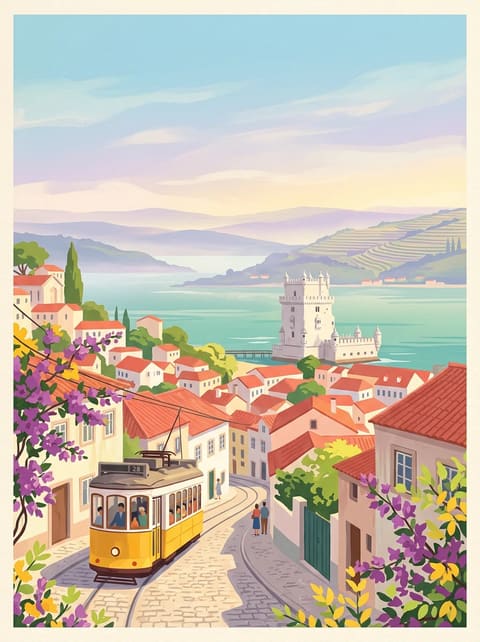
Step 3, the fixed points. In Belém, the Jerónimos Monastery and the Belém Tower open Tuesday to Sunday, 9:30 a.m. to 5:30 p.m., and close on Mondays, so Belém goes on Sunday. Pena Palace in Sintra sells palace tickets for a set date and time; the palace opens at 9:30 a.m., and private cars can't drive up to it, so you take the shuttle, public transport or a trail. That's a Monday booking, since Belém is closed then anyway. Trains from Lisbon's Rossio station reach Sintra in about 40 minutes.
Between the cities, the Alfa Pendular runs from Lisbon to Porto Campanhã in about 2 hours 45 minutes. A one-way ticket in 2026 costs €35.70 in Turística, the standard class, or €49.90 in Conforto.
The Douro Valley is the day trip, and it needed a check: the Douro line timetable in force since November 3, 2026 runs replacement buses on part of the route, from Caíde or Marco de Canaveses to Régua. On that timetable the 9:25 a.m. from Porto São Bento reaches Pinhão at 1:27 p.m., so a train day in the valley is now a long one. Check CP's current timetable before you plan it, or go with a tour from Porto.
- Day 1, Saturday: land, check in, and walk Baixa and Alfama in the evening. Dinner near the hotel.
- Day 2, Sunday: Belém. Jerónimos when it opens at 9:30, the Belém Tower, lunch by the river, a slow afternoon back toward the center.
- Day 3, Monday: Sintra. Train from Rossio, Pena Palace in your booked slot, then the town. Back in Lisbon for dinner.
- Day 4, Tuesday: the castle and Alfama in the morning, Chiado after lunch. The free half day is this afternoon.
- Day 5, Wednesday: the morning Alfa Pendular to Porto. The Ribeira riverfront in the afternoon, then across the river to the port cellars of Vila Nova de Gaia.
- Day 6, Thursday: the Douro Valley, by train to Régua or Pinhão or on a tour.
- Day 7, Friday: a last morning in Porto's center, then the flight home.
- Jerónimos MonasteryBelém. Tuesday to Sunday, 9:30 a.m. to 5:30 p.m.; closed Mondays.
- Belém TowerSame hours as the monastery, and also closed Mondays.
- Pena PalaceSintra. Palace tickets are for a set date and time; no private cars up the hill.
- Castelo de São JorgeThe castle above Alfama, for the Tuesday morning.
Why the week is in that order
Each choice comes from a step. The Monday closure put Belém on Sunday and Sintra on Monday. The timed Pena ticket made Sintra a booked day, not a maybe. The move to Porto sits on day 5, so each city gets its days in one block. The Douro, the longest day, sits on day 6, after the move and before the flight home, and the free half day sits in Lisbon, where there's always more to see.
Our ready-made 7-day Portugal itinerary follows the same shape, four days around Lisbon and Sintra, then Porto and the Douro, with every stop on a map. If three days in Lisbon is all you have, start with our Lisbon itinerary.
The same method for other weeks
One city: a single base, five city days by area and one or two day trips by train. A road trip is the exception to the three-night rule, because the drive is the point: keep driving days short and stop longer where it matters, as on our four-day route of the best scenic drives in Bahrain. For more ready-made weeks, see Iceland in 7 days, Ireland in 7 days and Costa Rica in 7 days, or, for a beach and island week, Mozambique in 7 days.
Day by day
Day 1
- Baixa
- Alfama
Day 2
- Jerónimos Monastery
- Belém Tower
Day 3
- Train from Rossio to Sintra
- Pena Palace
- Sintra town
Day 4
- Castelo de São Jorge
- Alfama
- Chiado
Day 5
- Alfa Pendular to Porto
- Ribeira
- Vila Nova de Gaia port cellars
Day 6
- Douro Valley: Régua or Pinhão
Day 7
- Porto center
- Flight home
Frequently asked questions
How do you plan a 7-day itinerary?
Count the real hours (arrival and departure days are half days), choose one or two bases, mark everything with a fixed day or time, give each day one area, put the day trip mid-week and leave half a day free. Then book timed tickets and trains.
How many cities can you visit in 7 days?
Two at most if you want to see them, with three or four nights in each. Every move costs about half a day. One city with a day trip or two is the most relaxed week.
Should I plan every hour of a 7-day trip?
No. Plan the fixed points to the hour: timed tickets, trains, a booked dinner. Give the rest of each day an area and a rough order, and keep half a day free.
What should I book before a 7-day trip?
Anything with a set time or limited places: timed entry to popular sights, long-distance trains, tours and the dinner you care most about. Check closing days on each venue's own site too, since many museums close one day a week.
Is 7 days enough for Portugal?
For Lisbon, Sintra, Porto and a day in the Douro Valley, yes, by train and without a car. Leave the Algarve beaches for another week or swap them in for Porto.